What a leader should know about four engineering disciplines outside their own. Each note covers the discipline’s core ideas, the questions to ask its experts, and one worked example.
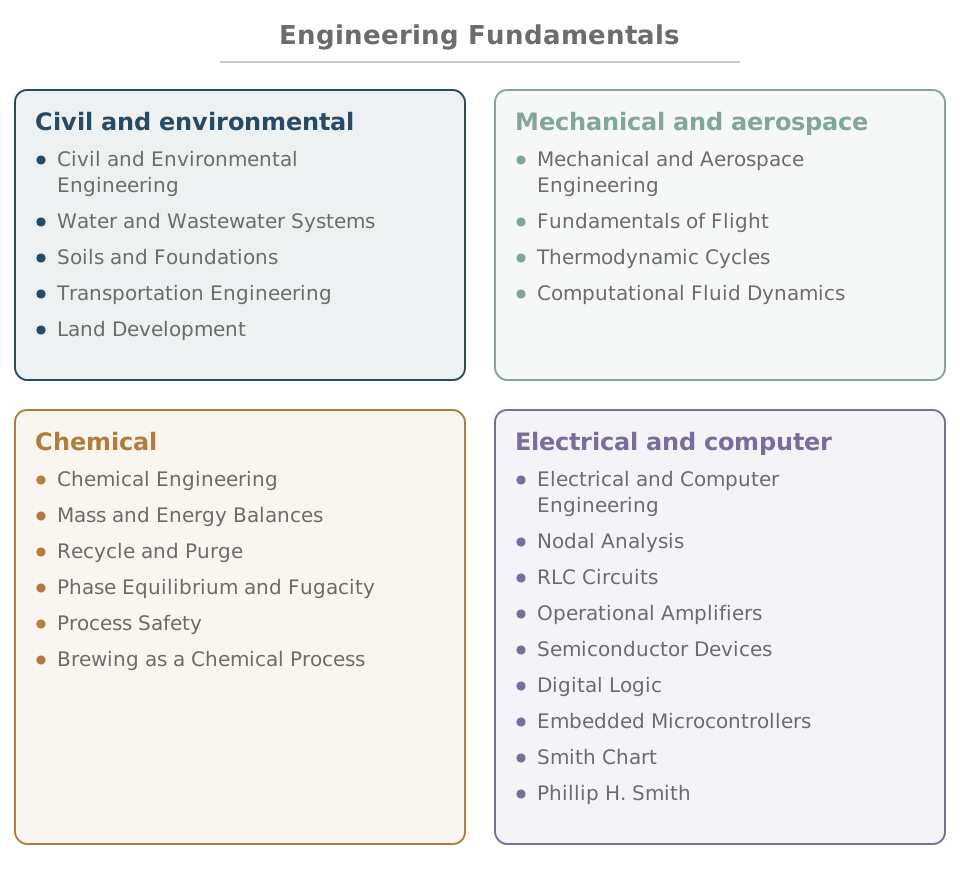
Clusters
Civil and environmental
- Civil and Environmental Engineering — the discipline in brief
- Water and Wastewater Systems — treatment and conveyance
- Soils and Foundations — the ground as an engineering material
- Transportation Engineering — moving people and goods
- Land Development — turning a parcel into a subdivision
Mechanical and aerospace
- Mechanical and Aerospace Engineering — the discipline in brief
- Fundamentals of Flight — lift, drag, thrust and weight
- Thermodynamic Cycles — heat pumps and energy conversion
- Computational Fluid Dynamics — simulation as a design tool
Chemical
- Chemical Engineering — the discipline in brief
- Mass and Energy Balances — what goes in must come out
- Recycle and Purge — reusing unreacted material without accumulation
- Phase Equilibrium and Fugacity — how species split between phases
- Process Safety — preventing catastrophic releases
- Brewing as a Chemical Process — beer as a worked example
Electrical and computer
- Electrical and Computer Engineering — the discipline in brief
- Nodal Analysis — solving circuits systematically
- RLC Circuits — energy storage and frequency response
- Operational Amplifiers — the analog building block
- Semiconductor Devices — diodes and transistors
- Digital Logic — gates, counters and state
- Embedded Microcontrollers — software meeting hardware
- Smith Chart — a graphical tool for impedance
- Phillip H. Smith — the engineer behind the Smith chart, as a leadership study
How this map connects
- Upstream: T-Shaped Professional
- Downstream: Connecting Across Disciplines · Systems Engineering
- Home: GIEL Knowledge Vault