In one line: The sequence of phases and gates that turns an opportunity into a launched product. It makes the work plannable, reviewable and coordinated across every function involved.
Core idea
A product development process is the agreed set of steps an organization follows to conceive, design and commercialize a product. In the widely used framing of Ulrich and Eppinger [1], a generic process has six phases, each ending in a review or gate where the organization decides whether to continue:
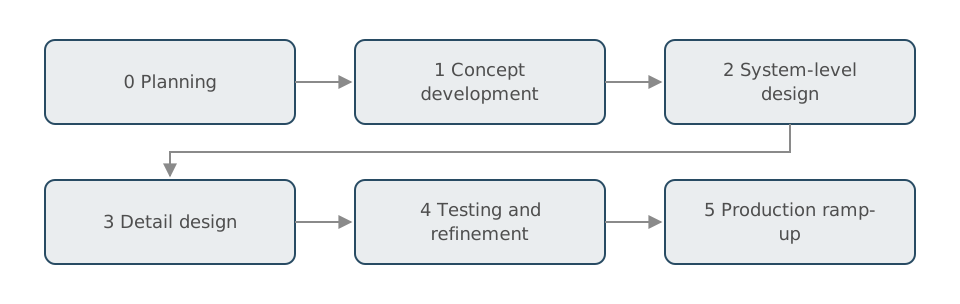
Gates typically include mission-statement approval, concept review, system specification review, critical design review, and production approval.
How it works
- Why have a process at all? It assures quality, coordinates the many functions involved (marketing, design, manufacturing, test, service), makes progress visible, supports planning, and captures lessons for next time.
- The process fits the product. Variants include:
- technology-push: start from a new technology and look for markets
- platform: build on an existing technology base
- user-driven (customer-pulled)
- process-intensive: the production process constrains the design
- customized: variations of a standard configuration
- high-risk: spiral or iterative processes that resolve uncertainty early
- quick-build: rapid build-test cycles, common in software
- complex systems: decomposed into subsystems developed in parallel
- Functions overlap in every phase. Marketing, design and manufacturing each have work in every phase; the process makes the hand-offs explicit.
- Gates are decisions, not ceremonies. Each gate is a chance to stop, redirect or invest further, based on technical, market and financial evidence.
In practice
A case used in the program, the launch of a server line built on a many-core, power-efficient processor, shows the stakes. The company bet a product generation on a new architecture, skipping a planned conventional design. That made the planning and concept phases, and the decision to commit, as important as the engineering that followed. A practical exercise is to find your own organization’s documented process and locate your current work in it. Many engineers discover that the formal process and the real one differ, and the gap is worth understanding.
Questions to ask yourself
- Which phase is my project actually in, and which gate comes next?
- Which process variant best describes my product, and does our process fit it?
- What evidence will the next gate require, and do we have it?
Connections
- Front end: Product Planning, Product Development Funnel.
- Who does the work: Product Development Organizations. After release: Engineering Change Control.
- Vocabulary: Program Project Process Product.
- Capabilities exercised: Realizing the Vision, Decision Making, Connecting Across Disciplines.