How an idea becomes a product: choosing what to build, understanding customers, specifying, designing, and making it pay. This territory follows the classic product design and development sequence.
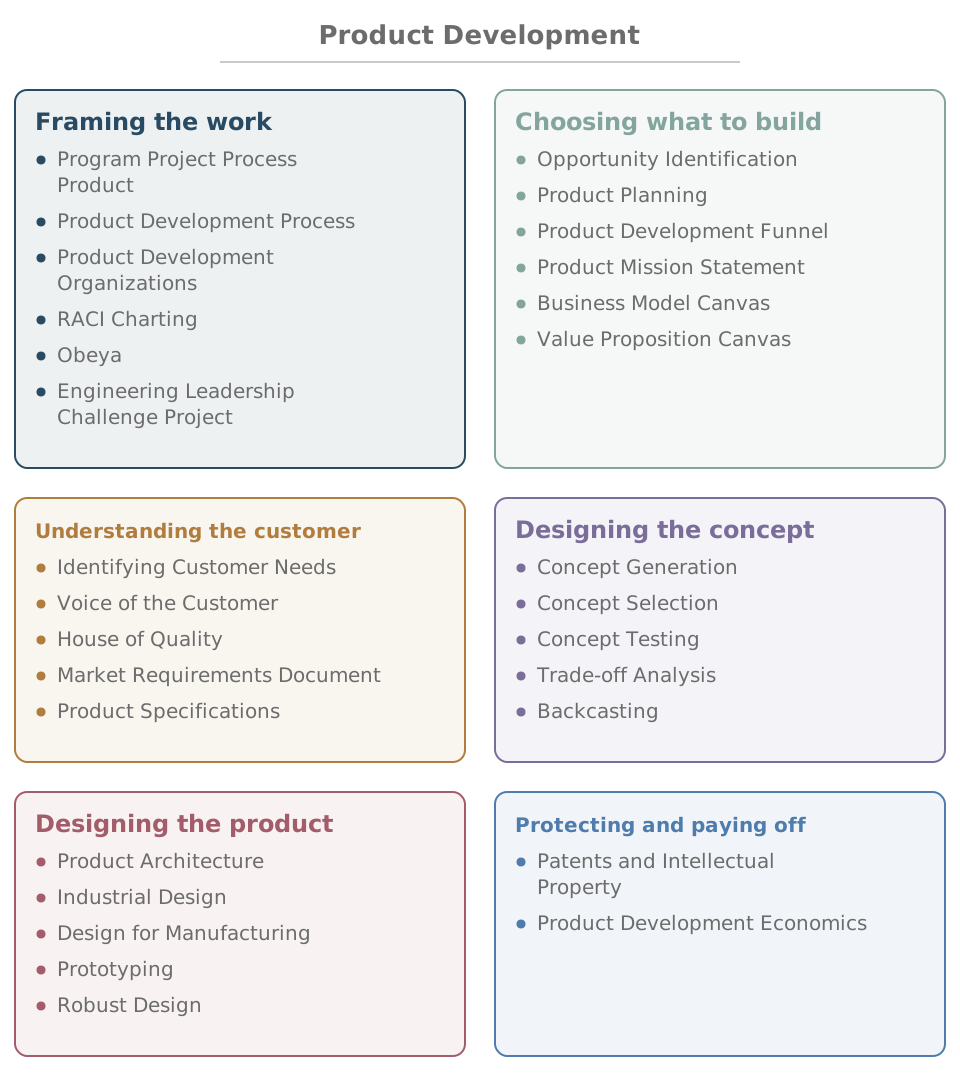
Clusters
Framing the work
- Program Project Process Product — four words engineers use loosely and should not
- Product Development Process — the staged path from opportunity to launch
- Product Development Organizations — functional, project and matrix structures and their trade-offs
- RACI Charting — making roles and decision rights explicit
- Obeya — the big room: making a program’s status visible to everyone
- Engineering Leadership Challenge Project — a year-long project that joins technical depth, business value and leadership
Choosing what to build
- Opportunity Identification — generating and filtering raw opportunities
- Product Planning — portfolios, roadmaps and which projects to fund
- Product Development Funnel — why the classic funnel picture misleads
- Product Mission Statement — a one-page charter for a development project
- Business Model Canvas — a one-page picture of how a business creates and captures value
- Value Proposition Canvas — fit between customer jobs, pains, gains and what you offer
Understanding the customer
- Identifying Customer Needs — turning raw customer statements into need statements
- Voice of the Customer — the research tradition behind needs gathering
- House of Quality — linking customer wants to engineering characteristics
- Market Requirements Document — the business-side statement of what the market needs
- Product Specifications — measurable metrics with units and target values
Designing the concept
- Concept Generation — widening the option space before narrowing it
- Concept Selection — screening and scoring concepts against criteria
- Concept Testing — checking the chosen concept with real customers
- Trade-off Analysis — making competing requirements explicit
- Backcasting — start from the desired future and work back to today
Designing the product
- Product Architecture — modular versus integral designs
- Industrial Design — aesthetics, ergonomics and the user’s experience
- Design for Manufacturing — designing to reduce cost and assembly difficulty
- Prototyping — prototypes for learning, communication, integration and milestones
- Robust Design — making performance insensitive to noise
Protecting and paying off
- Patents and Intellectual Property — what a patent discloses and protects
- Product Development Economics — net present value and sensitivity analysis for go/no-go decisions
How this map connects
- Upstream: Business and Strategy Map · Leadership Map
- Downstream: Systems and Quality Map · Operations and Supply Chain Map
- Home: GIEL Knowledge Vault