Who a leader is, how leaders work with people, and how they shape the organizations around them. This is the largest territory in the vault, and it is tied to everything else through the Engineering Leadership Capabilities.
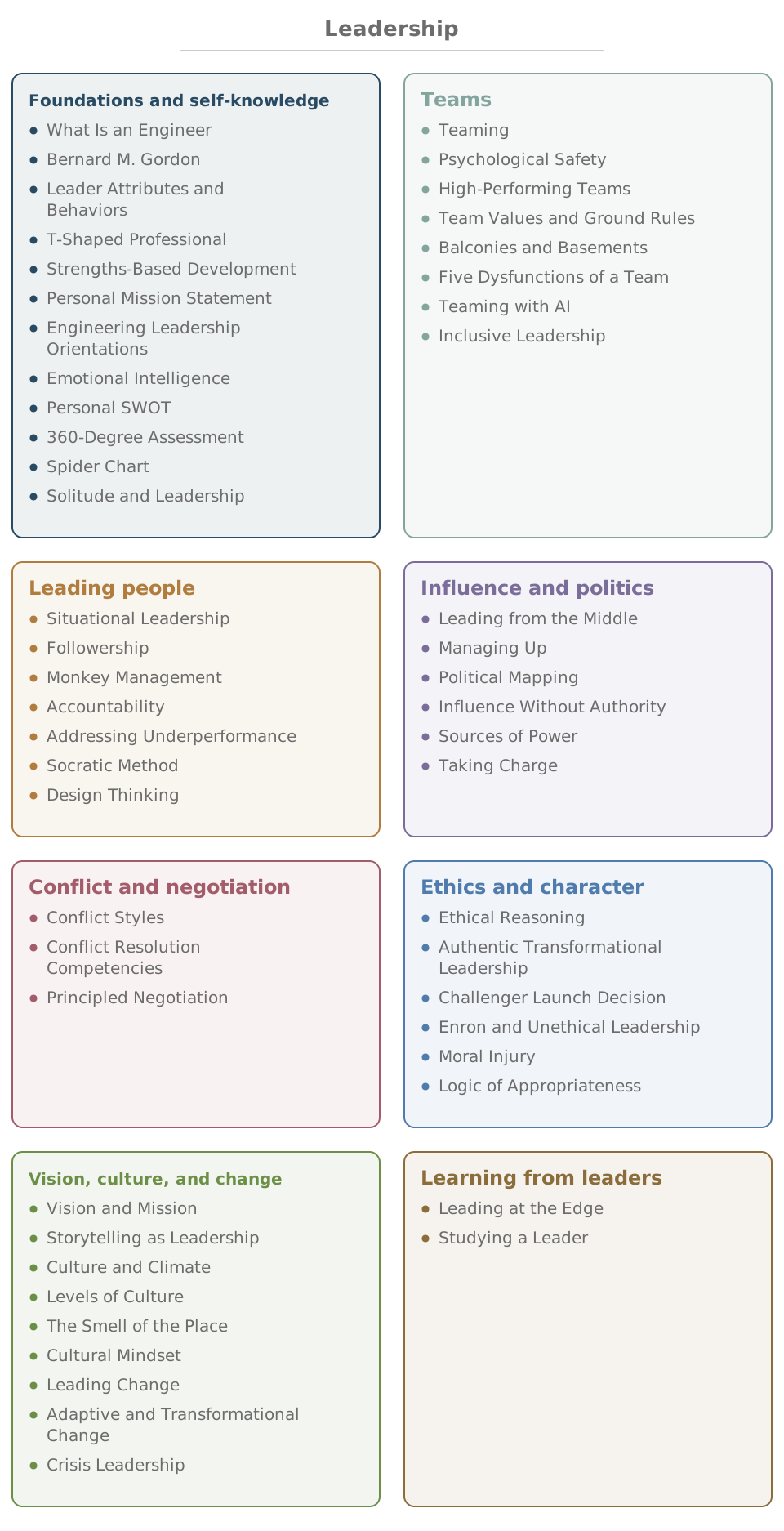
Clusters
Foundations and self-knowledge
- What Is an Engineer — the program founder’s view that engineers create and take responsibility for what they create
- Bernard M. Gordon — the engineer-entrepreneur whose ideas anchor the program
- Leader Attributes and Behaviors — what a leader is versus what a leader does
- T-Shaped Professional — deep in one discipline, broad across many
- Strengths-Based Development — build on natural talent instead of patching weaknesses
- Personal Mission Statement — a living document of values and priorities, revised for years
- Engineering Leadership Orientations — technical mastery, collaborative optimization and organizational innovation
- Emotional Intelligence — self-awareness and self-regulation as leadership skills
- Personal SWOT — strengths, weaknesses, opportunities and threats applied to yourself
- 360-Degree Assessment — the capability chart rated by self, manager and peer
- Spider Chart — the capabilities plotted as a radar chart, rated 0–10
- Solitude and Leadership — concentration and independent thought as leadership disciplines
Teams
- Teaming — teamwork as a verb: forming effective teams on the fly
- Psychological Safety — trust as the precondition for candor
- High-Performing Teams — the shared traits of teams that outperform, and the stages teams move through
- Team Values and Ground Rules — agreeing explicitly on how the team will behave
- Balconies and Basements — the same trait can be a strength or a liability
- Five Dysfunctions of a Team — trust underpins conflict, commitment, accountability and results
- Teaming with AI — AI as a supporting teammate with the human accountable
- Inclusive Leadership — leading so diverse identities are recognized and valued
Leading people
- Situational Leadership — match directing and supporting to the follower’s readiness
- Followership — the rules for supporting a leader well
- Monkey Management — who owns the next move on a problem
- Accountability — creating the conditions where people own outcomes
- Addressing Underperformance — the cost of leaving a performance problem alone
- Socratic Method — teaching and leading by questions
- Design Thinking — human-centered problem solving
Influence and politics
- Leading from the Middle — influence from any level of the organization
- Managing Up — aligning with a boss’s expectations and style
- Political Mapping — charting stakeholders by influence and stance
- Influence Without Authority — reciprocity and the currencies people trade
- Sources of Power — where a leader’s influence comes from
- Taking Charge — a structured approach to the first months in a leadership role
Conflict and negotiation
- Conflict Styles — competing, collaborating, compromising, avoiding and accommodating
- Conflict Resolution Competencies — the skills of working through a tough interaction
- Principled Negotiation — interests over positions, options before commitment
Ethics and character
- Ethical Reasoning — frameworks for working through a dilemma
- Authentic Transformational Leadership — why transformational leadership must rest on ethical character
- Challenger Launch Decision — how normalized risk and organizational pressure overrode engineering judgment
- Enron and Unethical Leadership — a culture that made misconduct normal
- Moral Injury — the harm of acting against, or being betrayed in, one’s own moral code
- Logic of Appropriateness — how organizational identity makes behavior feel rational
Vision, culture, and change
- Vision and Mission — where we are going versus what we do every day
- Storytelling as Leadership — stories as the carrier of values and vision
- Culture and Climate — long-lived shared assumptions versus the felt experience of a team
- Levels of Culture — artifacts, espoused values and basic assumptions
- The Smell of the Place — how context shapes energy and initiative
- Cultural Mindset — ethnocentric, plural and multicultural mindsets
- Leading Change — a staged approach to transformation
- Adaptive and Transformational Change — small gradual change versus a break with the status quo
- Crisis Leadership — leading before, during and after a crisis
Learning from leaders
- Leading at the Edge — Shackleton’s expedition as a study in leadership under extreme constraint
- Studying a Leader — choosing a leader to research in depth
How this map connects
- Upstream: Engineering Leadership Capabilities · Career and Communication Map
- Downstream: Product Development Map · Systems and Quality Map
- Home: GIEL Knowledge Vault