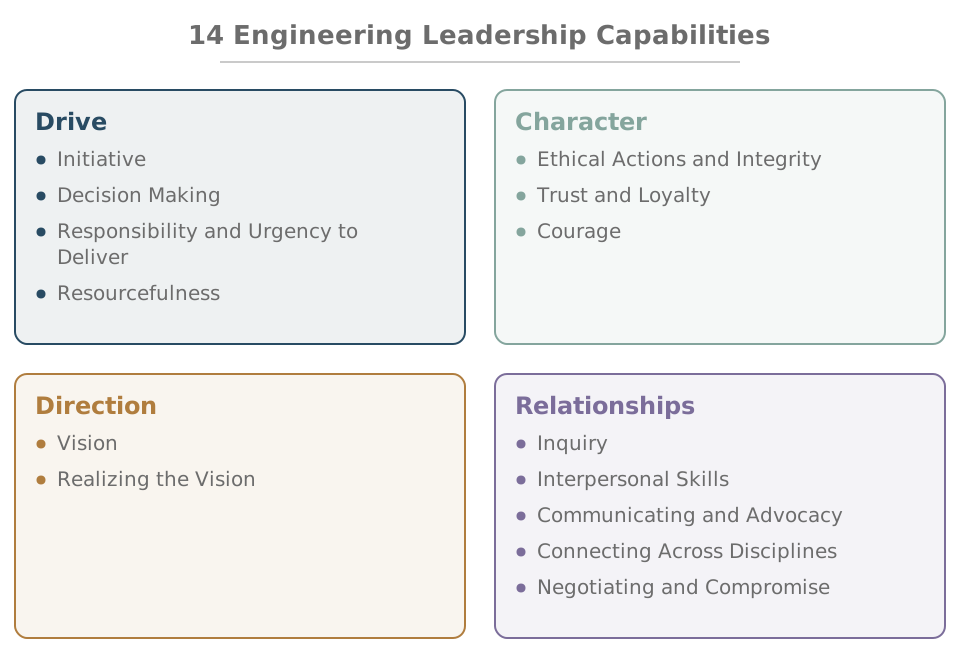
In one line: Fourteen capabilities that the Gordon program uses to describe what an engineering leader does. They are the yardstick for every reflection, assessment, and leadership story in the program.
The capabilities give leadership a vocabulary that engineers can assess and develop. The program measures them with one tool, the Spider Chart: a radar chart with one spoke per capability, rated 0 to 10. Candidates plot it at the start of the program, repeat it near the end with ratings from a manager and a peer (see 360-Degree Assessment), and use it to analyze leaders they study. Gaps between the self-view and others’ views are often more informative than the scores themselves.
In this vault, every concept note links to the capabilities it exercises, which makes these fourteen notes the hubs of the graph.
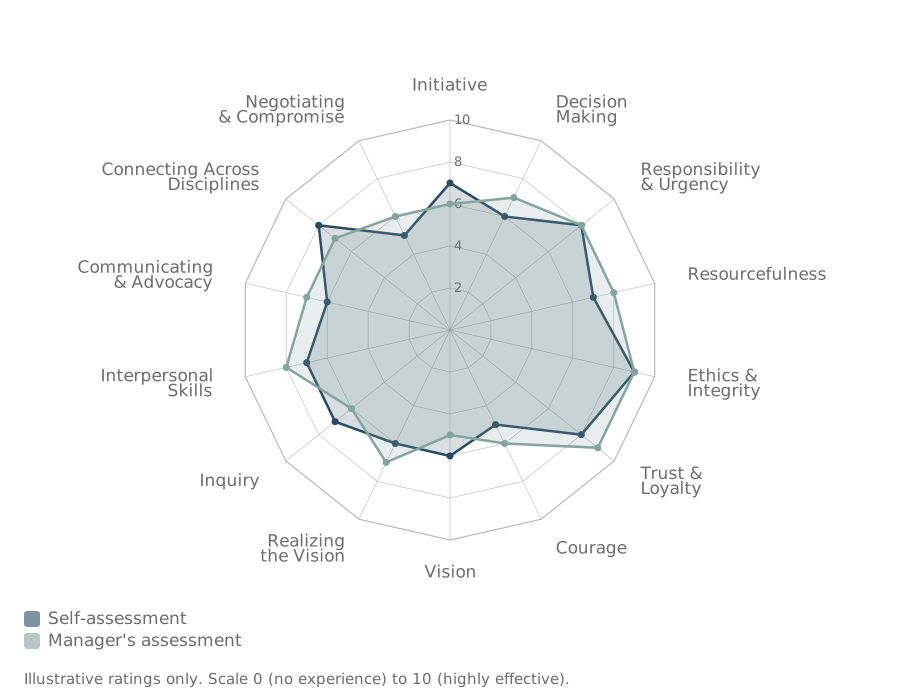 The same fourteen capabilities as a Spider Chart. Illustrative ratings only.
The fourteen, in four clusters
The cluster names are this vault’s own grouping, used to aid memory. They are not part of the official framework.
Drive
- Initiative — Acting before you are asked: sizing up the risk, picking a direction, and starting.
- Decision Making — Choosing well with incomplete information, and changing course when the facts change.
- Responsibility and Urgency to Deliver — Owning the outcome completely and pushing it over the line on time despite obstacles.
- Resourcefulness — Getting it done: focus, discipline, and flexibility applied to whatever is in front of you.
Character
- Ethical Actions and Integrity — Holding to ethical principles, and having the nerve to act on them when it costs something.
- Trust and Loyalty — Earning trust through reliable actions, and being loyal to the team so the team is loyal back.
- Courage — Facing hard, risky, or uncomfortable actions directly instead of around them.
Direction
- Vision — Imagining a compelling future: what new products, systems, or organizations could and should exist.
- Realizing the Vision — Turning an idea into a delivered result through process, planning, and sound judgment.
Relationships
- Inquiry — Listening to truly understand others’ thinking and feelings, assuming their ideas may beat yours.
- Interpersonal Skills — Respecting individual and group needs, recognizing strengths, and coaching with grace.
- Communicating and Advocacy — Explaining your view clearly to any audience and checking that you were actually understood.
- Connecting Across Disciplines — Engaging people with different expertise, skills, and cultures, and valuing what they see.
- Negotiating and Compromise — Spotting conflict early and negotiating toward solutions both sides can accept.
Using the framework
- Self-assessment: plot your Spider Chart quickly and by gut feel, then look for the two lowest and the two highest scores.
- 360 view: compare your chart with a manager’s and a peer’s, and treat any mismatch as a conversation starter.
- Lens on others: rate a historical leader to understand their style (see Studying a Leader).
- Lens on experience: when you reflect on a case or a reading, ask which capabilities were tested.