In one line: Most transformation efforts fail for predictable reasons. Successful change moves through a sequence of stages, from creating urgency to anchoring the new ways in culture, and skipping stages only creates the illusion of speed.
Core idea
John Kotter studied companies attempting major change and found that most fell short. The failures came from a handful of common errors: not establishing enough urgency, not building a strong enough guiding coalition, lacking a clear vision, under-communicating it, letting obstacles stand, not creating short-term wins, declaring victory too soon, and failing to embed the change in the culture. Reversing those errors gives an eight-stage process.
How it works
Our own grouping of the eight stages into three phases:
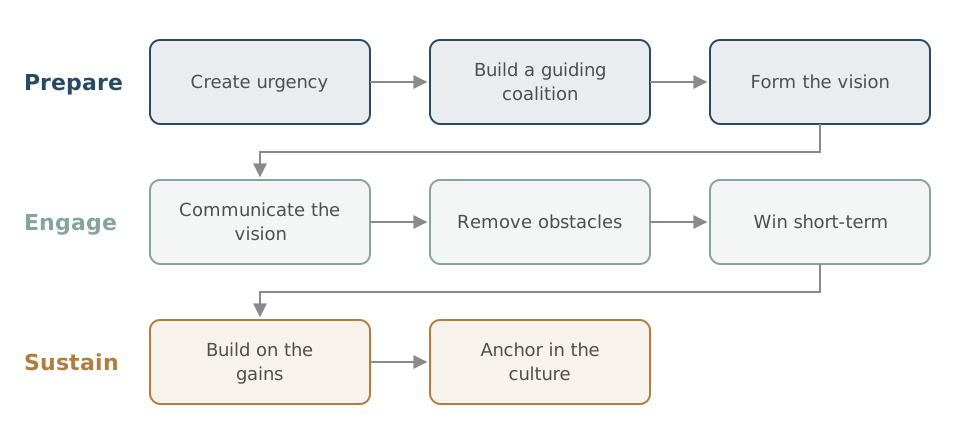
- Prepare the ground: make the need for change felt (complacency is the first enemy), assemble a coalition with enough power and credibility, and form a clear vision.
- Engage the organization: communicate the vision constantly, through words and leaders’ behavior, remove structures and people that block it, and plan visible early wins.
- Sustain it: use credibility from early wins to tackle bigger changes, and don’t declare victory too early. Then tie the new behaviors to success, so they survive leadership turnover.
In practice
The program also looks at change from the receiving end, where everyone’s first question is what the change means for them:
- Top management can be isolated from its impact.
- Middle managers are squeezed, expected to implement without enough information.
- Front-line employees often feel threatened and respond with denial.
After downsizing, the people who remain show a “survivor syndrome” of fear and guilt. Reflections on large mergers echo the same pattern: little communication beyond company-wide boilerplate, managers as uninformed as their teams, and funded work cut without explanation. Morale drops even among loyal staff. Communicating ten times more than seems necessary, and being honest about what isn’t yet known, is the leader’s most practical tool.
Questions to ask yourself
- For a change I want to make, how urgent does it feel to the people I need?
- Who belongs in my guiding coalition, and who is missing?
- What short-term win could I show within a month?
Connections
- Types of change: Adaptive and Transformational Change.
- The vision stage: Vision and Mission. The final stage: Culture and Climate.
- Case: Business Transformation. Engineering counterpart: Engineering Change Control.
- Capabilities exercised: Vision, Realizing the Vision, Communicating and Advocacy, Courage.