In one line: Some interventions in a system barely matter and some transform it. Changing numbers is weakest; changing the rules, goals and mindsets that shape the system is strongest, and hardest.
Core idea
Meadows ranks places to intervene in a system from least to most effective [1]. The counterintuitive message is that the interventions people reach for first, such as adjusting budgets, targets and quantities, are usually the weakest. The ones that change everything are deeper and more uncomfortable: the system’s information flows, rules, goals, and ultimately the paradigm it runs on.
How it works
Meadows lists twelve leverage points. Grouped from weak to strong:
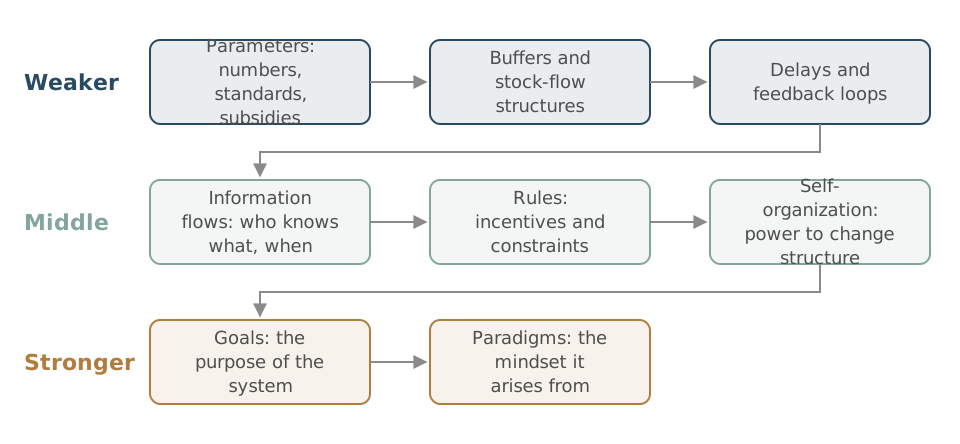
- Parameters (numbers) are the most common intervention and rarely change behavior on their own, unless they cross a threshold.
- Feedback loops gain leverage by changing how strongly the system corrects or amplifies itself.
- Information flows are surprisingly powerful. Making consequences visible to the people who cause them, such as an energy meter in the front hall, changes behavior without any new rule.
- Rules and goals decide what the system rewards and therefore what it does.
- Paradigms, the shared assumptions behind the goals, are the deepest point. Changing them changes everything, which is why they are so resisted.
In practice
Leverage points explain why many corporate initiatives disappoint. A new target (a parameter) imposed on an unchanged reward system (the rules) and an unchanged definition of success (the goal) produces gaming, not improvement. When choosing how to escape a system trap, it is worth asking which level the intervention operates at, and whether a higher one is available. Often the cheapest strong move is an information change: show people the real-time consequences of their decisions.
Questions to ask yourself
- When we try to fix a problem, which level are we usually intervening at?
- What information, if visible to the right people, would change behavior without a new rule?
- Which goal or assumption in my organization, if changed, would change the most?
Connections
- Framework home: Thinking in Systems. Applied to: System Traps.
- Organizational change: Leading Change, Logic of Appropriateness (the paradigm level). Flow systems: Theory of Constraints.
- Capabilities exercised: Vision, Decision Making, Courage.