In one line: A prototype is an approximation of the product built to answer a question. Decide what you need to learn first, then build the cheapest thing that answers it.
Core idea
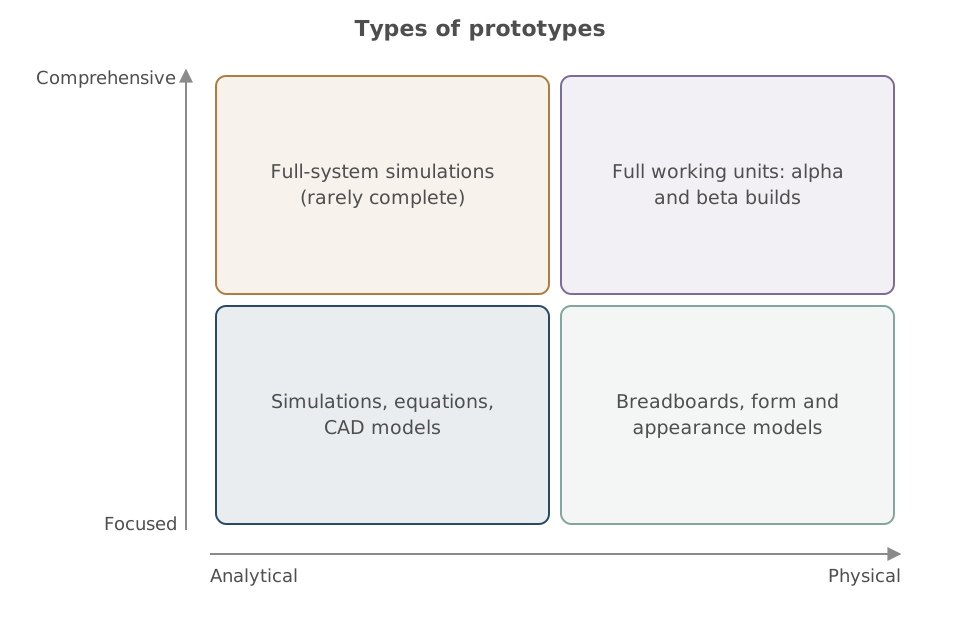
Ulrich and Eppinger define a prototype as an approximation of the product along one or more dimensions of interest [1]. That covers everything from a sketch or a spreadsheet model to a full working unit. They classify prototypes along two axes, which together give a useful map for choosing what to build:
How it works
Four purposes of prototypes:
- Learning: will it work, and how well does it meet needs?
- Communication: showing the idea to managers, customers and partners.
- Integration: making sure subsystems work together.
- Milestones: demonstrating that the product has reached a defined level of functionality.
Principles:
- Physical prototypes reveal unanticipated phenomena that analytical models miss.
- Prototypes can reduce the risk of costly iterations, so build early when the cost of a late surprise is high.
- Prototypes can expedite other steps, for example by giving manufacturing or test something real to plan around.
- They can restructure task dependencies, letting work proceed in parallel.
Planning a prototype:
- Define its purpose.
- Establish its level of approximation.
- Outline an experimental plan.
- Create a schedule for procurement, construction and test.
In practice
A practical exercise is to take a prototype from your own field and place it on the two-axis map, then ask which purpose it served. Engineering organizations often build integration and milestone prototypes on schedule but skimp on cheap learning prototypes early, when a quick breadboard or a simple model would have exposed the problem months sooner.
Questions to ask yourself
- What specific question is our next prototype meant to answer?
- Is there a cheaper, more focused prototype that would answer it sooner?
- Which of our risks would one early physical prototype retire?
Connections
- Related methods: Concept Testing, Design of Experiments, PDCA Cycle.
- Partner discipline: Industrial Design. Purpose: Risk Management.
- Capabilities exercised: Resourcefulness, Realizing the Vision, Inquiry.